
Zari Work Trends 2025: Why Metallic Handwork Is Dominating Couture
Step into any designer studio this year, and you’ll notice one thing immediately—metallic
handwork has taken over the couture conversation. Not quietly. Not subtly. It has arrived
with the confidence of a craft that knows its roots and its worth.
Zari Work Trends 2025, once reserved for heirloom bridal trousseaus and classical silhouettes, is rewriting its identity. Today, it’s bold. It’s architectural. It’s contemporary luxury shaped by age-old hands.
And as global couture pushes toward craftsmanship-driven stories, India’s Zari artistry is
standing right at the center of 2025 fashion trends.
This shift didn’t happen overnight. It grew out of a rising respect for handmade work, a
fatigue with fast fashion, and a deep desire among designers to infuse emotion into every
stitch. And metallic handwork—especially Zari—does exactly that.
Welcome to the world of Zari Work Trends 2025, where heritage meets high fashion and
tradition finds a fresh voice.
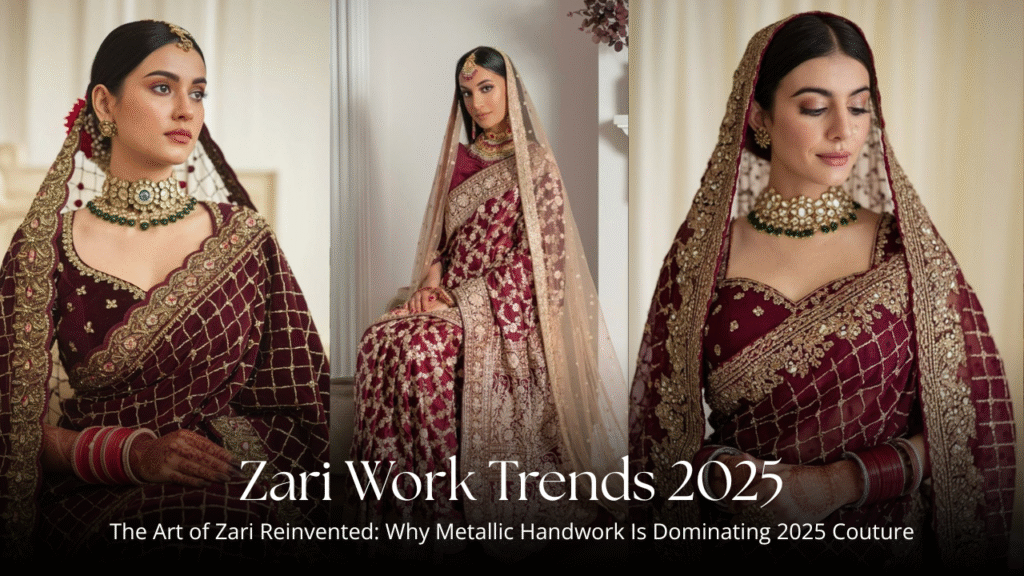
A Craft Born in History, Rediscovered by Zari Work Trends 2025
For centuries, Zari has been synonymous with royal wardrobes. Gold and silver threads
once adorned the garments of queens, nawabs, and noble families. The shine of the threads
wasn’t merely decorative; it represented status, celebration, and legacy.
But somewhere along the way, mass production diluted the magic. Machine-made shimmer
tried to replace the depth of handwoven beauty.
2025 is the year designers and buyers collectively said—never again.
There is a conscious return to craft. People want pieces that feel like stories. Brides want
garments that represent more than trends. And designers want to honor artisans who bring
emotion to fabric through skill passed down across generations.
This mindset has become the fuel of Zari’s renaissance.
Zari Work Trends 2025– Why Metallic Handwork Became the Heartbeat of Couture
Three major cultural movements have pushed Zari back into the spotlight—each shaping the
Zari Work Trends 2025 in a different way.
- A Global Shift Toward Handmade Luxury
In the last decade, couture buyers have changed. They no longer want ten outfits—they
want two exceptional ones. Pieces they can hold, preserve, maybe even pass on.
Handcrafted metallic detailing stands out because:
● It holds depth and texture machine embroidery can’t replicate.
● It feels personal—no two stitches are ever identical.
● It reflects time, effort, and human touch.
Designers across India, Europe, and the Middle East are weaving Zari into gowns, jackets,
lehengas, and even accessories, not just as decoration but as the central identity of the
design. - The Return of Statement Surface Art
Minimalism had its moment. But 2025 fashion is leaning into expressive, dramatic
surfaces—think structured metallic vines, three-dimensional motifs, antique gold textures,
and oversized Zari patterns.
Metallic handwork lets designers create silhouettes that are not loud, but powerful.
From champagne gold to muted copper and oxidized silver, the new-age Zari palette is
richer than ever—a major reason why metallic work is everywhere. - Brides Want Modern, But With Soul
Today’s bride is not interested in trends that disappear in six months. She wants:
● craftsmanship
● individuality
● cultural roots
● and contemporary structure
Zari gives her exactly this balance.
Designers are using a mix of traditional patterns (paisleys, florals, jaal) with modern
geometry and digital-inspired sequencing. The result? Bridal couture that feels rooted yet
fashion-forward.
The New DNA of Zari: What’s Trending in 2025
Here’s where the real transformation is happening. The techniques shaping Zari Work
Trends 2025 are not just updates—they are reinventions. - 3D Metallic Sculpting
A standout trend is raised Zari work that looks almost sculpted. Artisans are layering
threads, combining them with dabka, nakshi, and cut dana to create depth and shadow.
Designers love it because sculpted metallic motifs photograph beautifully under soft
lights—perfect for modern bridal shoots. - Liquid Gold & Silver Finish
Zari threads now come in ultra-refined finishes that look like melted metal on fabric. This is
especially popular for cocktail sarees, fluid gowns, and Indo-western drapes.
The effect? Elegant shine without overwhelming the outfit. - Matte Metallic Zari
A huge shift is the rise of matte surfaces. Think:
● muted gold
● tarnished silver
● champagne bronze
They complement pastel lehengas, minimalist silhouettes, and monochromatic layering. - Mixed-Material Handwork
Artisans are blending Zari with:
● glass beads
● pearls
● sequins
● resham
● crystals
This creates a textural dance between shine and softness. - Oversized Motifs with Negative Space
Designers are moving away from busy all-over work. Instead, they’re focusing on:
● statement motifs
● strategic placement
● bold geometry
Negative space gives Zari space to breathe, making outfits look elegant rather than heavy. - Zari on Unconventional Fabrics
2025 couture sees Zari embroidered on:
● organza
● vegan silk
● linen blends
● structured tulle
● denim for luxury pret
This opens doors for designers who want Indo-fusion pieces that feel young and fresh.
Artisans at the Center Stage—Finally
The revival of Zari is not just a trend; it’s a cultural correction.
For decades, artisans worked in the shadows, while the spotlight stayed on designers and
runways. In 2025, something beautiful is happening—
their names are being mentioned, their stories documented, and their craft valued.
Fashion houses are:
● investing in training
● preserving hand-embroidery clusters
● building fair-wage programs
● collaborating with artisans rather than treating them as labour
Consumers are also asking, “Who made this?”—and they are willing to pay for ethical,
detailed, handmade work.
This is one of the biggest reasons Zari work feels more meaningful than ever.
Zari Work Trends 2025 Goes Global: The World Is Watching
Metallic Indian handwork has travelled beyond borders. Some of the biggest couture houses
internationally now showcase Indian artisanship behind the scenes.
In fashion capitals, Zari is being used for:
● haute couture jackets
● runway gowns
● red carpet looks
● luxury bridalwear
● custom celebrity pieces
Designers admire Zari because it brings heritage into modern silhouettes without looking
dated.
The shift is simple: craft is the new luxury, and Zari fits perfectly into this global storytelling.
For Designers: What Zari Means in 2025
For designers, this year is a turning point. Zari no longer plays a supporting role—it leads the
narrative.
Choosing Zari in 2025 means:
● leaning into craftsmanship
● curating slow, meaningful collections
● collaborating deeply with artisans
● building pieces that stand out in a world full of digital replication
Designers who are integrating modern surface techniques with classical Zari motifs are the
ones setting trends, not following them.
For Buyers: Why Zari Pieces Are Investment Wear
A Zari garment in 2025 is not just an outfit. It is:
● a piece of culture
● a labor of patience
● a connection to generational skill
● a collector’s item
Buyers understand the difference between machine shimmer and handworked metallic art.
That awareness is pushing couture toward authenticity.
When someone chooses Zari today, they’re choosing heritage wrapped in modernity.
The Future of Zari: Where the Craft Is Headed
Zari’s journey is far from done. If anything, 2025 has opened the door for a new era of luxury
embroidery.
Expect to see:
● more sustainable metallic threads
● collaborations between designers and craft clusters
● digital designs translated into handwork
● experimental silhouettes featuring Zari as structure
● global couture houses showcasing Indian metallic embroidery as signature elements
The spirit of Zari lies in its adaptability, and the coming years will only expand its artistic
boundaries.
Final Word: Zari Is Not Just Back—It’s Leading the Couture Movement
The dominance of metallic handwork in 2025 is not a trend; it’s a cultural statement. Zari has
reinvented itself without losing its soul. It carries heritage, but speaks the language of today’s
couture.
As the world embraces handcrafted luxury, Zari Work Trends 2025 prove one thing
unmistakably— true artistry never fades; it only finds new ways to shine



Add comment