
Handcrafted vs Machine Made: What Every Bride Should Know Before Shopping in 2025
As a bride, you walk into boutiques with references saved on your phone, expectations set by Instagram, and a hundred opinions already in your head. Somewhere between “this looks beautiful” and “why is this priced like this?”, confusion quietly sets in.
One of the biggest reasons for that confusion is not design or colour.
It’s the lack of clarity around Handcrafted vs Machine Made bridal wear.
Most brides are never clearly told what they are buying. Words like handcrafted, handwork, and designer piece are used freely — sometimes correctly, sometimes not.
This article is written to change that.
Not to push a preference.
Not to judge choices.
But to give you honest knowledge, so you can shop with confidence and trust your decision long after the wedding day is over.
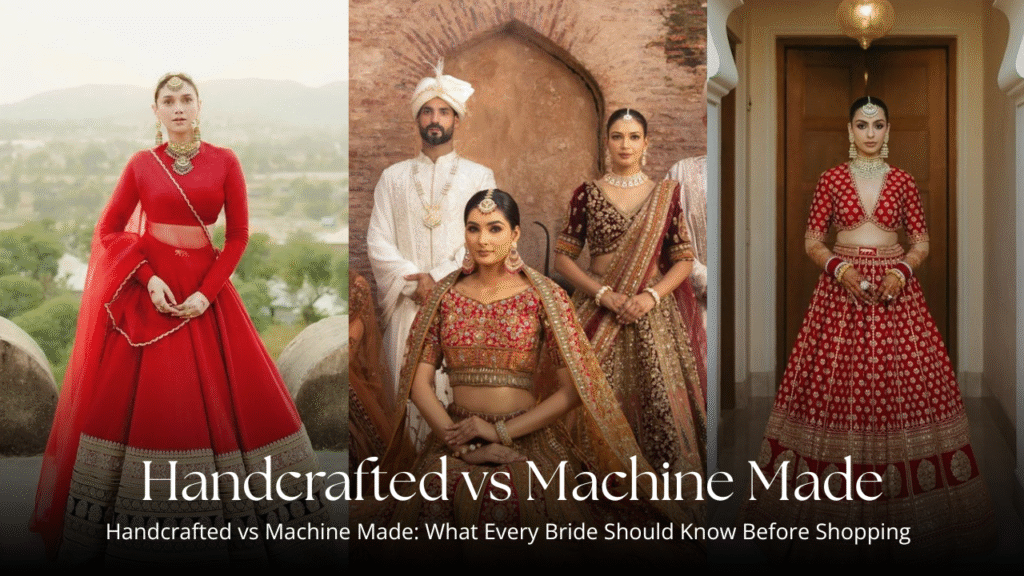
Handcrafted vs Machine Made: Why This Difference Matters More Than You Think
At first glance, two bridal outfits may look similar.
Heavy embroidery. Rich fabric. Detailed work.
But the process behind them can be completely different.
The difference between Handcrafted vs Machine Made is not just about technique — it affects:
- How the outfit feels on your body
- How it photographs
- How it ages over time
- Why it costs what it costs
When brides don’t understand this difference, disappointment often comes later — not at the store, but after the wedding.
And that’s exactly what awareness helps prevent.
What Does Handcrafted vs Machine Made Mean in Bridal Wear?
Handcrafted bridal wear is made slowly.
Not in factories.
Not through programmed patterns.
But by skilled artisans who work with their hands, eyes, and years of experience.
Every motif is created stitch by stitch.
Every panel passes through multiple hands.
What you’ll notice in handcrafted bridal wear
- Slight variations in embroidery (a sign of human work)
- Rich texture that feels dimensional, not flat
- Softer fall over time as the fabric settles
- Details that look better the closer you see them
Handcrafted vs Machine Made pieces carry time within them. That time shows — quietly, beautifully.
They are not meant to be rushed.
They are meant to be worn with intention.
Machine Made Bridal Wear: What It Is — and What It Is Not
Machine made bridal wear is often misunderstood.
It is not “cheap work.”
It is not “fake.”
It is simply different in process.
In machine made outfits, embroidery designs are digitised and executed by machines. This allows faster production and uniform results.
Why many brides choose machine made
- Shorter timelines
- More affordable pricing
- Clean, consistent patterns
- Suitable for lighter functions or multiple outfits
Machine made bridal wear serves a purpose — especially in today’s fast-paced wedding timelines.
The problem begins only when it is presented as handcrafted.
Handcrafted vs Machine Made: The Difference You Can Feel, Not Just See
One of the simplest ways to understand Handcrafted vs Machine Made is to touch the outfit.
Handcrafted embroidery usually feels:
- Slightly raised
- Flexible with movement
- Organic in spacing
Machine embroidery often feels:
- Flat
- Structured
- Uniform throughout
Neither is right or wrong.
But they feel different — and that matters when you wear an outfit for hours.
Why Handcrafted Bridal Wear Costs More (And Why That’s Honest)
This is one of the most common questions brides ask — often silently.
Handcrafted bridal wear costs more because:
- Skilled artisans are paid for time, not speed
- Techniques require years of training
- Production takes weeks or months
- Work cannot be duplicated instantly
You are not paying only for fabric or embellishment.
You are paying for human skill and time.
When this is explained transparently, pricing feels justified — not confusing.
As a bride, you walk into boutiques with references saved on your phone, expectations set by Instagram, and a hundred opinions already in your head. Somewhere between “this looks beautiful” and “why is this priced like this?”, confusion quietly sets in.
One of the biggest reasons for that confusion is not design or colour.
It’s the lack of clarity around Handcrafted vs Machine Made bridal wear.
Most brides are never clearly told what they are buying. Words like handcrafted, handwork, and designer piece are used freely — sometimes correctly, sometimes not.
This article is written to change that.
Not to push a preference.
Not to judge choices.
But to give you honest knowledge, so you can shop with confidence and trust your decision long after the wedding day is over.
Handcrafted vs Machine Made: Why This Difference Matters More Than You Think
At first glance, two bridal outfits may look similar.
Heavy embroidery. Rich fabric. Detailed work.
But the process behind them can be completely different.
The difference between Handcrafted vs Machine Made is not just about technique — it affects:
- How the outfit feels on your body
- How it photographs
- How it ages over time
- Why it costs what it costs
When brides don’t understand this difference, disappointment often comes later — not at the store, but after the wedding.
And that’s exactly what awareness helps prevent.
What Does Handcrafted Actually Mean in Bridal Wear?
Handcrafted bridal wear is made slowly.
Not in factories.
Not through programmed patterns.
But by skilled artisans who work with their hands, eyes, and years of experience.
Every motif is created stitch by stitch.
Every panel passes through multiple hands.
What you’ll notice in handcrafted bridal wear
- Slight variations in embroidery (a sign of human work)
- Rich texture that feels dimensional, not flat
- Softer fall over time as the fabric settles
- Details that look better the closer you see them
Handcrafted pieces carry time within them. That time shows — quietly, beautifully.
They are not meant to be rushed.
They are meant to be worn with intention.
Machine Made Bridal Wear: What It Is — and What It Is Not
Machine made bridal wear is often misunderstood.
It is not “cheap work.”
It is not “fake.”
It is simply different in process.
In machine made outfits, embroidery designs are digitised and executed by machines. This allows faster production and uniform results.
Why many brides choose machine made
- Shorter timelines
- More affordable pricing
- Clean, consistent patterns
- Suitable for lighter functions or multiple outfits
Machine made bridal wear serves a purpose — especially in today’s fast-paced wedding timelines.
The problem begins only when it is presented as handcrafted.
Handcrafted vs Machine Made: The Difference You Can Feel, Not Just See
One of the simplest ways to understand Handcrafted vs Machine Made is to touch the outfit.
Handcrafted embroidery usually feels:
- Slightly raised
- Flexible with movement
- Organic in spacing
Machine embroidery often feels:
- Flat
- Structured
- Uniform throughout
Neither is right or wrong.
But they feel different — and that matters when you wear an outfit for hours.
Why Handcrafted Bridal Wear Costs More (And Why That’s Honest)
This is one of the most common questions brides ask — often silently.
Handcrafted bridal wear costs more because:
- Skilled artisans are paid for time, not speed
- Techniques require years of training
- Production takes weeks or months
- Work cannot be duplicated instantly
You are not paying only for fabric or embellishment.
You are paying for human skill and time.
When this is explained transparently, pricing feels justified — not confusing.



Add comment