
Vintage Bridal Fashion: Don’t Miss the Return of the Heirloom Saree in 2026
Wedding fashion changes constantly. Colours come and go, silhouettes evolve, and trends rise and disappear almost overnight in Vintage Bridal Fashion.
Yet something meaningful is returning to bridal wardrobes — not loudly, not as a trend, but almost quietly. Heirloom sarees are being taken out again, not just to be looked at, but to be worn.
These are sarees once worn by grandmothers, then carefully folded away by mothers who never imagined they would come back into use. For years, they stayed tucked inside cupboards, wrapped in muslin, taken out occasionally during festivals or family weddings. Today, brides are choosing to bring them back — restoring them, restyling them, and wearing them with confidence on their wedding day.
It isn’t only about nostalgia. For many brides, it’s about feeling connected — to family, to tradition, to something real. At a time when bridal fashion moves quickly and trends change every season, wearing a vintage saree feels intentional. It carries weight, memory, and meaning that no newly bought outfit can replace.
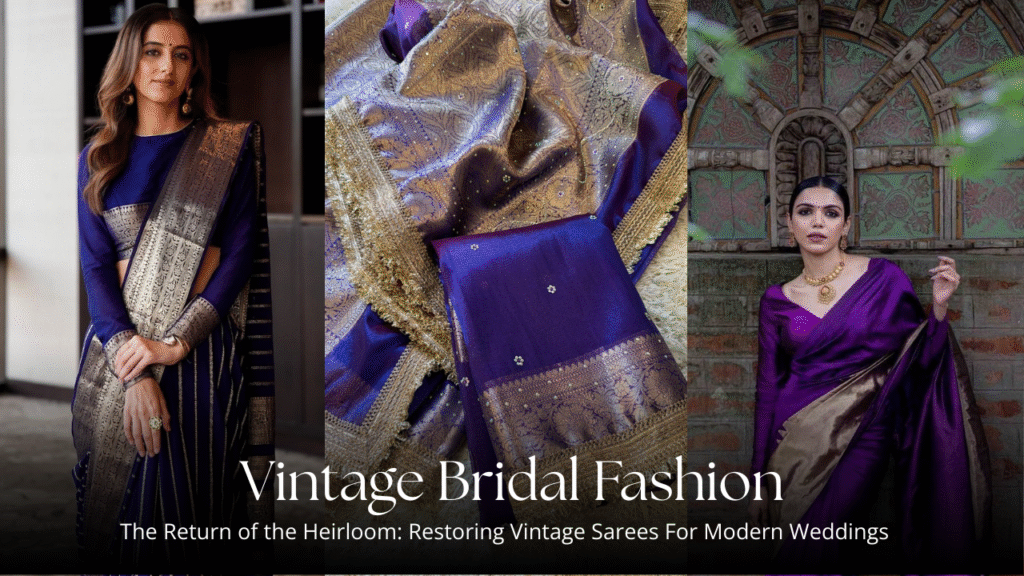
For a long time, heirloom sarees were admired from a distance. Brides loved looking at them but hesitated to wear them, worried they might feel too old, too fragile, or simply out of place in a modern wedding. In many ways, Vintage Bridal Fashion was seen as something to preserve, not participate in.
That way of thinking is slowly shifting.
Modern brides are no longer chasing novelty for the sake of it. They are looking for depth, authenticity, and emotional connection. An heirloom saree offers all of that effortlessly. It carries the touch of generations, the weight of memories, and a sense of continuity that no newly bought outfit can recreate. This renewed appreciation is redefining Vintage Bridal Fashion as something deeply personal rather than outdated.
Whether it’s a Banarasi silk from the 1970s, a Kanjeevaram worn at a mother’s wedding, or a handwoven cotton saree dyed with natural colours — each piece tells a story. And when a bride wears it again, that story becomes part of her own. In this way, Vintage Bridal Fashion transforms from a beautiful memory into a living legacy.
The Gentle Art of Restoration in Vintage Bridal Fashion
Restoring a Vintage Bridal Fashion saree is a careful, almost intimate process. It isn’t about altering the saree beyond recognition. It’s about preserving its soul while making it wearable for today.
The journey usually begins with a detailed inspection. Over time, silk may weaken, zari can dull, and colours may soften. Skilled artisans clean the fabric gently, reinforce fragile areas, and repair tears using traditional techniques — never harsh treatments that compromise the weave.
The borders usually need the most attention. Over time, the handwork softens, the zari dulls, or a section simply wears thin. Skilled artisans work slowly here, repairing the embroidery thread by thread. In some cases, parts can’t be saved. When that happens, old motifs taken from vintage textiles are carefully added in, so the saree still feels like itself — not altered, just restored.
The blouse is where most brides choose to experiment. It becomes the point where the past meets the present. A clean, modern cut can completely change how an heirloom saree is seen, without taking anything away from it. Some brides keep it minimal, others play with structure. A few add detachable elements like veils, belts, or capes, which let them style the saree in different ways while leaving the original fabric untouched.
The beauty lies in restraint. The saree stays timeless. The styling does the talking.
More Than an Outfit: The Emotional Weight of Heirlooms
Wearing an heirloom saree is an experience that goes far beyond fashion. Brides often speak about feeling grounded, protected, and deeply connected when they drape a saree once worn by someone they love.
It often turns into a shared moment, one that crosses generations without anyone really planning it that way.
A mother steps in to help with the drape and ends up talking about when the saree was worn the first time. Elders pause a little longer, offering blessings that feel quieter but heavier with meaning. Even the photographs carry something different. They don’t just record how the bride looked — they hold fragments of memory, layered into the fabric itself.
At a time when weddings are increasingly styled for the camera, heirloom sarees bring the focus back to what’s actually happening. They slow things down. They remind everyone present that a wedding isn’t only about how it appears, but about the people, the relationships, and the history that led to that moment.
Sustainability That Feels Natural, Not Performative
For many brides, the choice isn’t only emotional. It’s practical and conscious as well.
Restoring a saree that already exists means one less garment being produced, one less contribution to waste. In many ways, vintage bridal fashion shifts attention away from mass-made bridal wear and toward something that was created to last — often by artisans whose work was never meant to be worn just once.
Older sarees were made differently. Pure silks, natural dyes, and handwoven techniques were the norm, not the exception. These qualities are what give vintage bridal fashion its depth and quiet strength, even decades later.
Choosing to restore and wear such pieces today aligns effortlessly with the principles of slow fashion, even if that’s not the reason a bride begins the journey. For many, vintage bridal fashion starts as an emotional choice and gradually reveals its ethical value.
Sustainability, after all, isn’t new. It was part of tradition long before it had a name. Vintage bridal fashion simply carries that understanding forward, without needing to announce it.
Styling Heirloom Sarees for Today’s Bride
There’s a common belief that heirloom sarees limit creativity. In practice, they offer far more freedom than most people expect.
Brides are styling vintage sarees in ways that feel personal rather than prescribed in vintage bridal saree curation. Some keep the jewellery minimal for smaller, daytime ceremonies, while others lean into heavier temple pieces for more traditional rituals. Hair is rarely overdone — soft buns, loose waves, or relaxed braids are becoming far more common than tightly set bridal styles.
How the saree is worn also depends on the moment. A few brides choose heirloom pieces for sacred ceremonies like the pheras or muhurtham, changing into something lighter later on. Others let the saree be their main bridal look, trusting its history and craftsmanship to speak for itself.
Every choice — makeup, footwear, accessories — is intentional, allowing the saree’s story to shine without overpowering it.
Creating the Heirlooms of Tomorrow
When a bride restores and wears a vintage saree, she isn’t only honouring the past. Through vintage bridal fashion, she’s also creating something new.
That saree now holds another memory of its own. Each time vintage bridal fashion is lived and worn, it adds a new layer to a story that was already rich with meaning.
One day, it may be folded away again, waiting to be taken out years later, carrying stories that didn’t exist before. This is where vintage bridal fashion quietly reveals its power — allowing fashion to be emotional and circular, without needing to say so.
Seen this way, vintage bridal fashion isn’t about looking back. It isn’t about nostalgia alone or recreating the past exactly as it was.
Instead, vintage bridal fashion becomes a conscious choice about how you move forward, and what you choose to carry with you into the future.
A Quiet Shift in Bridal Fashion
The return of heirloom sarees isn’t loud or trend-led. It hasn’t arrived with rules or announcements. It’s simply happening, one wedding at a time.
As more brides choose to restore rather than replace, the meaning of luxury is shifting. It’s less about something being new, and more about how it was made, who it belonged to, and why it still matters.
When a bride wears an heirloom saree, she isn’t just wearing fabric. She’s carrying family, memory, and care — stitched together over time.
And that, in itself, feels like a statement worth making.



Add comment